
Art Deco, Streamline Moderne, Mediterranean Revival and MiMo explained
Streamline Moderne and Tropical Deco are kinds of Art Deco. Mediterranean Revival was prominent before it, and MiMo came after.
The Miami Design Preservation League says three styles define Miami Beach’s architecture: Art Deco, Mediterranean Revival and Miami Modern, called MiMo. Streamline Moderne and Tropical Deco are kinds of Art Deco. The sources here are the league’s style pages, the City of Miami Beach and a paper hosted by the National Park Service.
At a glance
- Streamline Moderne
- Art Deco’s sleeker second phase: curves and machine-age forms
- Tropical Deco
- Deco with local relief ornament: plants, animals, ocean liners
- Mediterranean Revival
- Stucco, arches and clay tile, prominent in the 1920s
- MiMo
- Post-war modern; the city says most examples are in Mid and North Beach
- Pastel paint
- A designer’s scheme applied to buildings that had mostly been white
How the styles fit together
The City of Miami Beach gives a short timeline. Art Deco takes its name from a 1925 exposition in Paris. The first Art Deco buildings in Miami Beach appeared in 1933, with a local twist the city says is sometimes called tropical art deco. The city’s Mediterranean Revival page says that style became prominent in the 1920s, so it came before Deco. MiMo followed World War II: the late 1940s through the 1960s by the city’s dating, and the 1950s by the league’s.
Streamline Moderne and Tropical Deco are not separate from Art Deco. The league calls Streamline Moderne Art Deco’s sleeker, more sober second act: elaborate ornament gave way to aerodynamic curves and machine-age forms. Tropical Deco is the local part, relief ornament of plants, animals and ocean liners on a Deco building. A plainer sub-style, Stripped Classic, shows up mainly in government buildings, and the league names the U.S. post office on Washington Avenue as the finest local example.
The styles side by side
| Style | When | Look for | A building the sources name |
|---|---|---|---|
| Mediterranean Revival | Prominent in the 1920s | Stucco, arches, clay barrel tile, wrought iron, courtyards | Española Way; Casa Casuarina (1930) |
| Art Deco, including Streamline Moderne | First Miami Beach examples in 1933 (city) | Symmetry, curved corners, eyebrows, stepped rooflines, porthole windows, glass block, neon | Colony Hotel, 736 Ocean Drive (1935); Carlyle, 1250 Ocean Drive |
| Tropical Deco | From 1933 (city) | Relief panels of pelicans, palms, waves, ocean liners | None named for this label; the league’s Art Deco walk is Ocean Drive, 5th to 15th Streets |
| MiMo | Late 1940s to 1960s (city); 1950s (league) | Asymmetry, cut-out screens, mosaic walls, louvers, flat roofs with projecting eaves, large glass | Fontainebleau, 4441 Collins Avenue (1954) |
What to look at on a building
On an Art Deco building the league says to start with symmetry, then count details in threes. After that, look for these.
- Eyebrows: shades above windows. The league’s Colony Hotel record lists continuous eyebrows that wrap around rounded corners.
- Stepped rooflines: the league calls them ziggurat rooflines, stepping upward like stylized pyramids. Its Colony record lists a stepped ziggurat parapet.
- Rounded corners: curved corners and edges. The league’s example of pure Streamline Moderne is the Carlyle, which it describes with three vertical columns and curved corners.
- Porthole windows: round windows borrowed from ocean liner design.
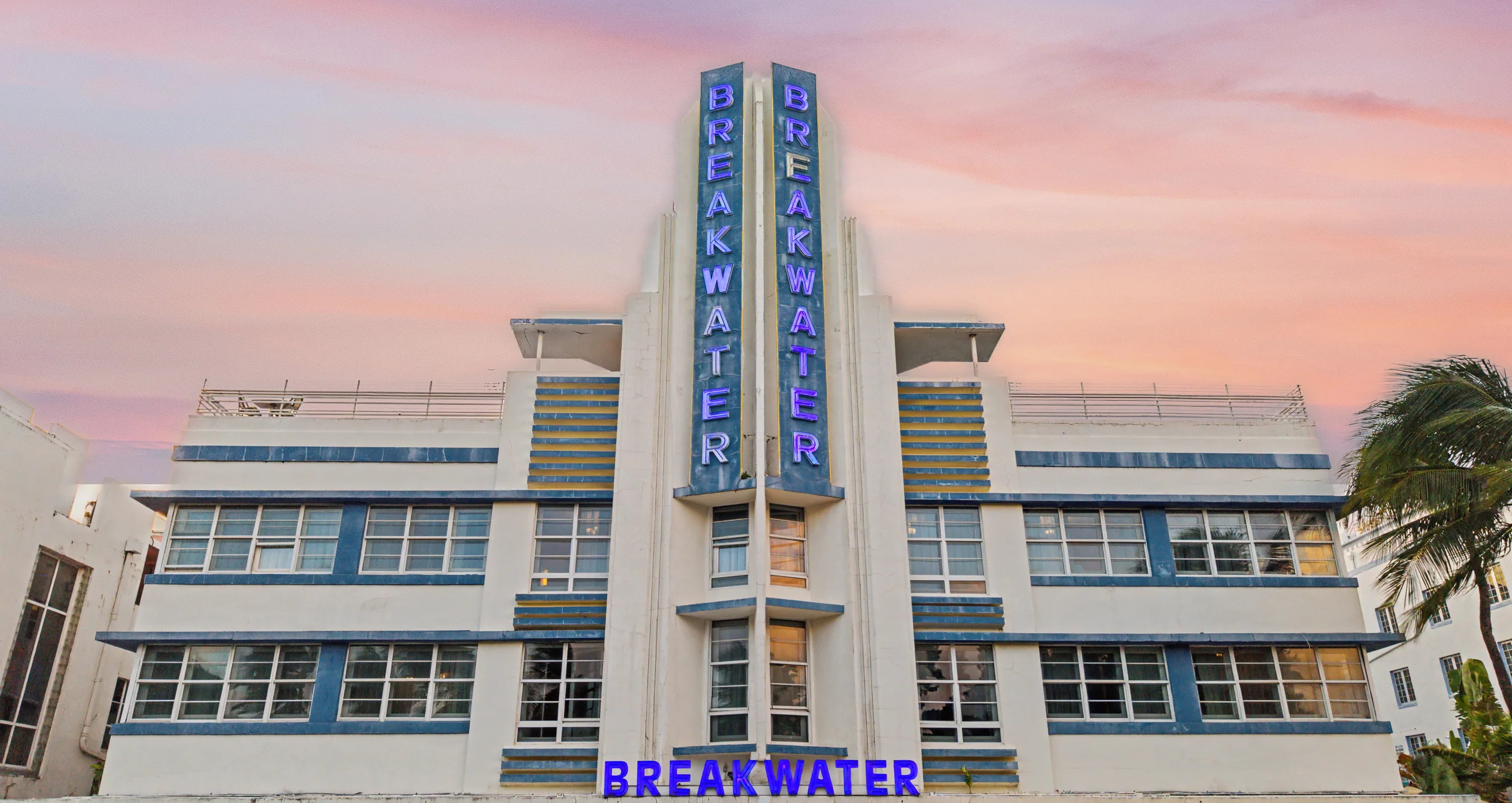
- Vertical sign elements: a tall feature that carries the hotel name. The league’s records describe one on the Colony and, at the Breakwater, an imposing vertical element holding the neon sign.
- Terrazzo: marble chips set in Portland cement, then ground and polished, according to the Library of Congress. The league’s record of 940 Ocean Drive notes a terrazzo porch, and a league article lists terrazzo floors among the defining 1930s features.
- Glass block, sculptural panels and neon are on the league’s list of Art Deco details.
- MiMo clues: drop the symmetry. The league lists asymmetry, cut-out concrete screens, mosaic walls and metal louvers, and says the Deco eyebrow awning evolved into the louvers. The city adds flat roofs with projecting eaves and large areas of glass.
Where to see them from the hotel
Times are about, rounded, from the front door with no crowds, from OpenStreetMap routing. The Art Deco Welcome Center at 1001 Ocean Drive is about 2 to 3 minutes away. Casa Casuarina, the former Versace mansion, is about 3 minutes; the league and the city both list it as Mediterranean Revival, built in 1930. Española Way, about 12 to 13 minutes, is what the league calls the richest single block for studying Mediterranean Revival. Its dates differ by source: the city lists 1925, and a league blog post says Francis F. Whitman built a Spanish colony there in 1922 and N.B.T. Roney bought it in 1925. The league’s pick for Art Deco is Ocean Drive from 5th to 15th Streets, and the hotel is at 10th Street, inside that stretch.
MiMo is mostly further north. The city says most MiMo properties are in Mid and North Beach, and attributes that to timing: South Beach was already built up with Art Deco when MiMo arrived. The league puts the richest concentration on Collins Avenue in North Beach, between 50th and 63rd Streets. The league and city MiMo pages name no building near 10th Street. To string the Deco stops together, see the self-guided walk. The league’s own tours are covered in the walking tour guide.
Where the pastel colors came from
The pastels are newer than the buildings. The paper is by the architectural conservator Tania Alam, from a 2018 preservation conference. It says South Beach’s hotels, apartment buildings and stores were historically mostly painted white, with small touches of jade green, ochre or coral. It dates the palette to the late 1970s and says the pastel look first appeared in the 1980s.
The interior designer Leonard Horowitz, also a league member, drew his colors from the sun, sky, sand and ocean, the paper says. The body color of one building would carry over to the trim of the next. The paper says South Beach buildings today are painted in colors such as peach, cream, mauve, aqua, shell pink, golden sand, seafoam green, Caribbean blue and sunrise orange.
The first building painted with the scheme was Friedman’s Bakery at 7th Street and Washington Avenue, in cotton candy pink, periwinkle blue, buttercream and mint green. WLRN captions a Library of Congress photo of the all-white bakery as about 1980. The paper says reaction was unfavorable at first and that more buildings were painted within a year. The bakery was on the cover of Progressive Architecture in 1982. The paper credits the palette with saving many oceanfront hotels from demolition and names the Breakwater among those still standing, but it says the palette was not the only factor. Its abstract says such palettes may not be accurate, but they work.
The two buildings at 940 and 960
The league’s record for 940 Ocean Drive calls the Breakwater Art Deco with Moderne influences and says it was built in 1939. It lists a terrazzo porch and an imposing vertical element that carries the neon sign. A 2024 league article calls the Edison at 960 an Art Deco / Mediterranean landmark, built between 1933 and 1935 and designed by Henry Hohauser. A separate league article on the Breakwater’s architect, Anton Skislewicz, says his background in ship design probably inspired many of his Streamlined Moderne buildings. Where sources disagree on dates, see the history guide.
Questions
What is the difference between Art Deco and Streamline Moderne?
The Miami Design Preservation League calls Streamline Moderne Art Deco’s sleeker, more sober second act. Elaborate ornament gave way to aerodynamic curves and machine-age forms.
What is Tropical Deco?
The league uses the name for Art Deco with local ornament: relief panels of plants, animals and ocean liners on a Deco building. The City of Miami Beach dates the first Art Deco buildings with a local twist, sometimes called tropical art deco, to 1933.
Is there MiMo architecture near the hotel?
As of October 23, 2026, the City of Miami Beach says most MiMo properties are in the Mid and North Beach neighborhoods, and the league puts the richest concentration on Collins Avenue between 50th and 63rd Streets. The league and city MiMo pages name no building near 10th Street.
Are the pastel colors original?
A paper hosted by the National Park Service says South Beach’s hotels, apartment buildings and stores were historically mostly painted white, with small touches of jade green, ochre or coral, before the designer Leonard Horowitz created his pastel palette. It says the look first appeared in the 1980s.
What style is the Breakwater?
As of October 23, 2026, the league’s building record calls 940 Ocean Drive Art Deco with Moderne influences, built in 1939. A 2024 league article calls the Edison next door at 960 an Art Deco / Mediterranean landmark built between 1933 and 1935.
Sources
- Miami Design Preservation League, Miami Design Styles (checked Oct 23, 2026)
- Miami Design Preservation League, Speed, Style & Sunshine: Art Deco Miami Beach (checked Oct 23, 2026)
- Miami Design Preservation League, Arches, Courtyards & Clay Tiles: Mediterranean Revival (checked Oct 23, 2026)
- Miami Design Preservation League, Jet Age Cool: Miami Modern (MiMo) (checked Oct 23, 2026)
- Miami Design Preservation League, building record: Breakwater Hotel (checked Oct 23, 2026)
- Miami Design Preservation League, building record: Colony Hotel (checked Oct 23, 2026)
- Miami Design Preservation League, Flamingo Plaza Hotel (list of 1930s defining features) (Sept 2020)
- Miami Design Preservation League, Edison Hotel and the 1987 state loan (May 2024)
- Miami Design Preservation League, Española Way: Miami Beach’s Historic Mediterranean Plaza (May 2023)
- Miami Design Preservation League, article on the architect Anton Skislewicz (interview with his granddaughter) (undated; URL path 2021/02)
- City of Miami Beach, Architecture (timeline and styles) (checked Oct 23, 2026)
- City of Miami Beach, Art Deco (checked Oct 23, 2026)
- City of Miami Beach, Mediterranean Revival (checked Oct 23, 2026)
- City of Miami Beach, MiMo (Miami Modern) (checked Oct 23, 2026)
- National Park Service (hosted), Color Pallets to the Rescue: Saving Buildings from Demolition (Tania Alam, from the 2018 Are We There Yet? conference) (page updated Jan 18, 2024)
- WLRN, Meet the man behind all those South Beach pastels (Nov 16, 2013)
- Library of Congress, Inside Adams blog, Terrazzo: Beauty Under our Feet (Apr 1, 2011)
- OpenStreetMap foot routing (routing.openstreetmap.de), run by the hotel for this guide (Oct 20, 2026)
Facts and prices change. Checked October 23, 2026. If something here is out of date, call the front desk on (305) 532-2362.
More guides
A self-guided Art Deco walk on Ocean Drive, in 10 stops
Ten Art Deco stops on Ocean Drive, each with an address and a sourced note, starting at our front door. 6 min read
MDPL Art Deco walking tour: price, start point and booking
What the league's two-hour walking tour costs, where it starts, how to book it and what else MDPL offers. 6 min readStaying on Ocean Drive?
The hotel is at 940 Ocean Drive, across the street from Lummus Park and the beach. Rates are on the booking page.