
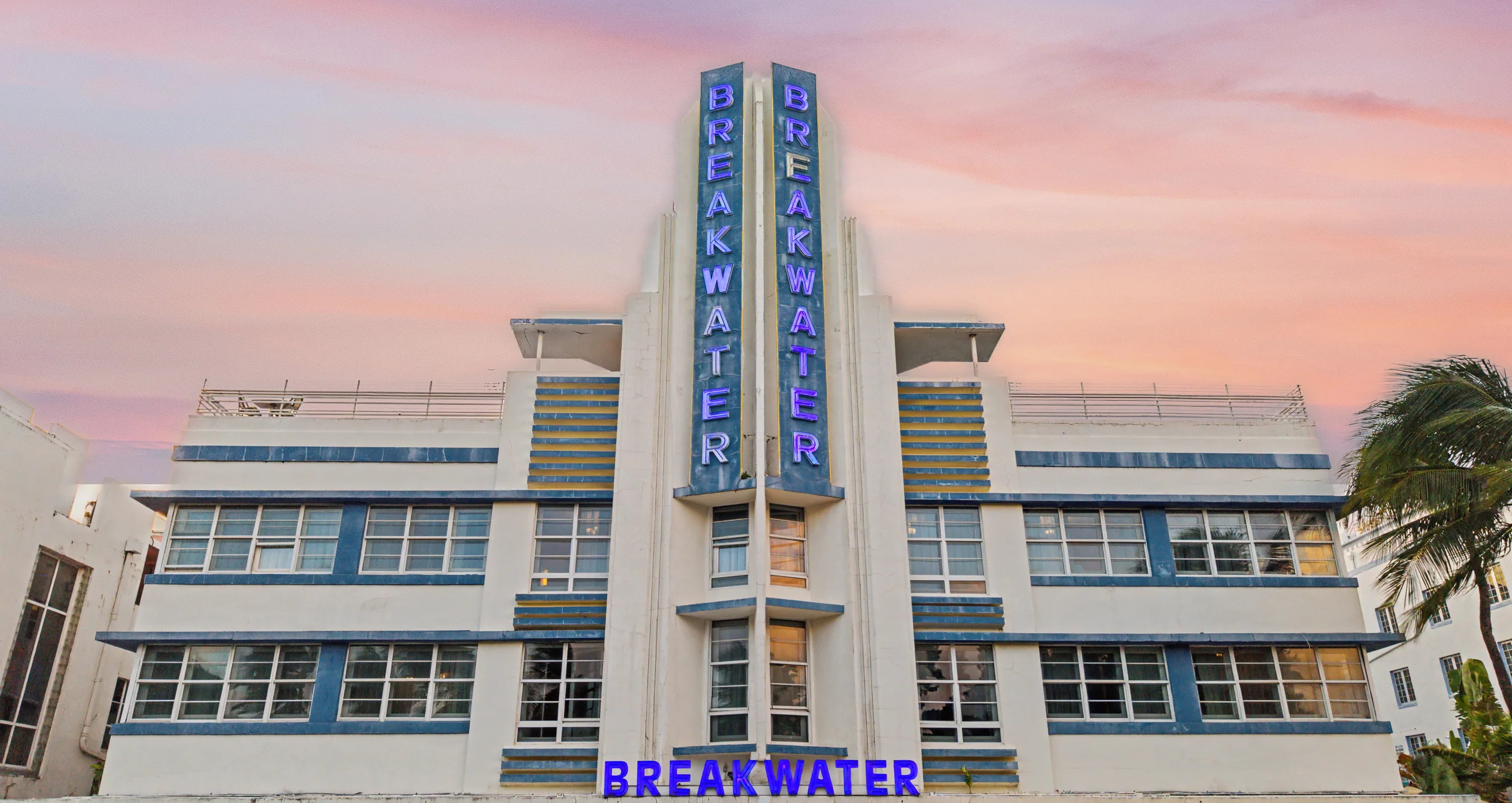
Española Way: the history of Miami Beach’s Spanish village
Española Way began in the 1920s as a Spanish-style village and became a City of Miami Beach historic district in 1986. From the hotel it is about 12 to 13 minutes on foot, by OpenStreetMap routing.
At a glance
- From the hotel
- About 12 to 13 minutes on foot (OpenStreetMap routing estimate, no crowds)
- Built
- 1922 and 1925 both appear in the sources
- Developers
- N.B.T. Roney, with a developer named Whitman (Francis or William, depending on the source)
- Architect of the Spanish Village
- Robert A. Taylor
- Style
- Mediterranean Revival, plus 1930s Art Deco and Moderne
- City historic district
- Ordinance adopted July 23, 1986 (per MDPL)
- Spelling
- The 1986 city report omits the tilde; current city pages use it
From 10th and Ocean
Española Way is about 12 to 13 minutes on foot from the hotel. That is an OpenStreetMap foot-routing estimate from the point the map uses for 940 Ocean Drive, with no crowds, not a stopwatch time. The walking times guide has the method and the other destinations. The visitors bureau describes the street as three blocks south of Lincoln Road (see our Lincoln Road guide).
Who built it
The City of Miami Beach’s 1986 designation report is the fullest account we found. It says Francis F. Whitman built the street in 1922 as Whitman’s Spanish Colony, and that in 1925, at the peak of the first Florida land boom, N.B.T. Roney and the Spanish Village Corporation bought the undeveloped land. The Miami Design Preservation League (MDPL) gives the same two dates in its Española Way article.
According to the report, Roney and his architect, Robert A. Taylor, with financial backing from Whitman, set out to build a miniature Spanish village. Roney envisioned an artists’ colony. Taylor modeled the village on San Sebastian and a town the report spells Fontarable on the Spanish coast, and on Biarritz, Cannes and Mentone in France. The report puts the project on one block between Washington and Drexel Avenues: 16 buildings, including two 50-room hotels, apartment buildings and shops, at an estimated cost of $1.5 million.
What the buildings look like
The report calls the Spanish Village Mediterranean Revival. It says the style fit the climate, with large overhangs, covered galleries and thick stuccoed walls, and that it was the prevailing style of the 1920s. Features it lists include archways, towers, bracketed balconies, barrel tile, wrought iron and decorative Spanish tile. MDPL describes peach stucco with striped shades. The visitors bureau describes chalky pink stucco, Spanish tile roofs and striped awnings. The city’s architecture page says only colorful.
Not everything on the street dates from the 1920s. The report says the 1926 hurricane and the Great Depression halted development on Miami Beach, and that the elaborate Mediterranean Revival style had become too costly to continue. It says the rest of the street was developed mostly from 1933 to 1940, in Art Deco and Streamline Moderne, by architects including Henry Hohauser and L. Murray Dixon. It cites Hohauser’s Allen Apartments (1936, 611 Española Way) as an Art Deco example, and lists his Grandora Apartments (1935, 724 Española Way) among its Mediterranean Revival examples. Hohauser also designed the Edison at 960 Ocean Drive, the second building of our hotel.
Those are the report’s 1986 descriptions, so check a building’s current use before you hunt for it. The Art Deco styles guide explains the terms, and the self-guided Art Deco walk covers buildings nearer the hotel.
A decline, then the 1986 designation
The report says artists never adopted the street. It says the Spanish Village drew a more raucous crowd instead, and that by the late 1930s the street had begun a “seedy slide.” It adds that a gambling syndicate was reputed to have run from the street until the 1950s, that its hotels housed soldiers training in World War II, and that dance studios opened afterward, when the street was called “The Rhumba Capital of the World.”
The Historic Preservation Board voted 7 to 0 on February 6, 1986 to nominate the properties along the street, and the report is dated March 1986. According to MDPL’s history, the City Commission adopted Ordinance No. 86-2511 on July 23, 1986, designating the Española Way District and the Ocean Drive and Collins Avenue District as Miami Beach’s first historic preservation districts. The hotel’s block is in the second one (see the building’s history). The report also says the nominated district lies entirely inside the National Register Architectural District.
The street was rebuilt around 2017. Time Out Miami reported on May 24, 2017 that the work cost $2.5 million over about a year, replaced the pavement and sidewalk and made Española Way pedestrian-only, with a reopening scheduled for June 6. A Time Out listing page dated January 5, 2018 describes the same work as finished. The city’s bollard project page, marked completed, lists bollards at the Washington Avenue and Drexel Avenue ends for summer to fall 2018 and says some of them retract for fire and emergency vehicles.
The street today
As of October 23, 2026, the city’s architecture page describes Española Way as a pedestrian street in the Mediterranean Revival style, designed to resemble a Spanish village. The visitors bureau’s page on the street, which carries no date, lists restaurants, art galleries, shops, gelaterias and hotels. MDPL’s article mentions late-night salsa dancing. Businesses, hours and events change, so check a venue’s own page before you go.
Where the sources differ
| Question | What we found |
|---|---|
| When was it built? | The city’s 1986 report says Whitman built the street in 1922, and also says Roney bought undeveloped land in 1925 and dates the Spanish Village to 1925. The city’s architecture page lists 1925 as the year built. The visitors bureau says Roney conceived the village in 1925. We could not find out what stood in 1922. |
| What was Whitman’s first name? | The report says Francis F. Whitman for the 1922 street, William Whitman for the 1930 houses on Jefferson Avenue, and William F. Whitman for the financier in its criteria section. MDPL’s 2023 article says Francis. An MDPL archive page says William. We cannot say which is right, or whether the report means one man. |
| How far does it run? | The report puts the Spanish Village on one block between Washington and Drexel Avenues, and the historic district from Collins Avenue to Jefferson Avenue. The visitors bureau says two blocks between Washington and Pennsylvania Avenues. Time Out and the city’s bollard page put the rebuilt stretch between Washington and Drexel. |
Questions
How far is Española Way from 940 Ocean Drive?
As of October 23, 2026, about 12 to 13 minutes on foot, by an OpenStreetMap routing estimate with no crowds. It is a map estimate, not a stopwatch time.
When was Española Way built?
Sources give two dates. The City of Miami Beach’s 1986 report says Whitman built it in 1922 as Whitman’s Spanish Colony, and that N.B.T. Roney and the Spanish Village Corporation bought the undeveloped land in 1925. The city’s architecture page lists 1925 as the year built.
Is Española Way a historic district?
Yes. As of October 23, 2026, the city’s architecture overview page names Española Way among the areas its historic districts cover. According to the Miami Design Preservation League, the City Commission designated the Española Way District on July 23, 1986, one of Miami Beach’s first two historic preservation districts.
Can you drive on Española Way?
As of October 23, 2026, the city’s architecture page calls it a pedestrian street. The city’s bollard project page lists bollards at the Washington Avenue and Drexel Avenue ends, some of them retractable for fire and emergency vehicles. We did not find the city’s rules on deliveries, or on the street west of Drexel Avenue.
Sources
- City of Miami Beach Planning Department, Española Way Historic Preservation District Designation Report (scanned PDF, all 19 pages read) (March 1986)
- Miami Design Preservation League, Española Way: Miami Beach’s historic Mediterranean plaza (2023 (from the URL; the page shows no date), checked Oct 23, 2026)
- Miami Design Preservation League, from the Archives: Española Way (undated, checked Oct 23, 2026)
- Miami Design Preservation League, history and timeline (Ordinance No. 86-2511, July 23, 1986) (checked Oct 23, 2026)
- City of Miami Beach, Studies and Designation Reports (lists the Espanola Way 1986 report) (checked Oct 23, 2026)
- City of Miami Beach, Mediterranean Revival architecture page (checked Oct 23, 2026)
- City of Miami Beach, Architecture overview (historic districts section names Española Way) (checked Oct 23, 2026)
- City of Miami Beach, Española Way bollard installation (project page) (checked Oct 23, 2026)
- Time Out Miami, Española Way is finally reopening after months of construction (May 24, 2017)
- Time Out Miami, Española Way (listing page) (January 5, 2018 (date shown on the page), checked Oct 23, 2026)
- Greater Miami Convention and Visitors Bureau, Inside Miami’s historic Spanish village (undated page, checked Oct 23, 2026)
- OpenStreetMap foot routing (routing.openstreetmap.de), run by the hotel for the walking guide (Oct 20, 2026)
Facts and prices change. Checked October 23, 2026. If something here is out of date, call the front desk on (305) 532-2362.
More guides
A self-guided Art Deco walk on Ocean Drive, in 10 stops
Ten Art Deco stops on Ocean Drive, each with an address and a sourced note, starting at our front door. 6 min readWalking from 10th and Ocean: how long it takes
Minutes on foot to the beach, the Art Deco district, Lincoln Road and South Pointe, and how we worked them out. 2 min readStaying on Ocean Drive?
The hotel is at 940 Ocean Drive, across the street from Lummus Park and the beach. Rates are on the booking page.